Recently our community experienced a horrendous tragedy. The most deadly avalanche in the history of California buried a dozen people near Castle Peak on Tuesday, February 17th. As the hours and days rolled on and rescuers attempted to reach the ill-fated party of 15 people, our community reeled with fear, dread, anger, uncertainty, and grief.
Our attempts to understand the unfathomable resulted in a variety of clashing coping mechanisms. Out of respect for those who have been directly affected by the trauma, I have held off on sharing my thoughts for a couple of weeks. Those who had friends, relatives, and colleagues involved have been stricken with a profound loss, rescuers who witnessed the devastation have been traumatized, as have to varying extents, the majority of people in our small community. Everybody knows somebody who knows somebody, and the whole idea that 3 extremely knowledgeable guides and 6 moms, who were all friends, would perish together in an excruciatingly horrendous way is beyond our worst imagination. We are all grieving not only for those lost, but also for the 6 surviving victims of this tragedy. Each day since, I have thought about the children who no longer have moms, the parents who no longer have children, the widowed spouses, and the rescuers who saw unthinkable horrors on the scene. I think about the friends and colleagues who lost loved ones, and the people who love backcountry winter recreation who are reckoning with their choices.
Before the New York Times published a detailed account by two survivors, many backcountry industry workers and enthusiasts rushed to call for sympathy for the victims and to defend the practice of taking calculated risks and enjoying the outdoors. They have backed the common practice of studying and recreating in avalanche-prone areas. And in fact, like many Tahoe locals, I myself regularly recreate in areas that have a variety of risks, including avalanches. I am no expert in avalanches or grief, but over the decades I have lived and recreated in this area I have observed various patterns, conditions, and risks.
Like many people who first heard of the incident, my first thought was “Who was it? There is a high likelihood that I know the victims and a low likelihood of survival!" My second thought was a gnawingly persistent incredulity that multiple people would voluntarily put themselves in such a risky time and place in the name of recreation. In fact, only a month prior, a snowmobiler succumbed to an avalanche in close proximity to Tuesday’s mass casualty event. To underline how risky I thought it was to be in that place during a predicted powerful storm, it will be helpful to lay out my actions during that timeframe.
A week prior to the incident we were experiencing icy conditions in the ski areas, which can create an unstable, slippery surface for new snow. At that time, I was planning a road trip to visit my mom in the Bay Area. I had to juggle work commitments with anticipated weather closures on highway 80, which passes within a few feet of the trailhead that the backcountry party used. I figured if I left on a Saturday, then I would have time to get back home before the storm if I got an early start the following morning. On Sunday morning, it was already raining in the Bay Area. Presumably this is when the ill-fated party left for their trip to the Frog Lake huts. In the accounts that were later published, group members were excited about their luck and timing to catch powder turns in the forecasted fresh snow.
Meanwhile, on Sunday morning, I was worried that I had initiated my return car trip too late. The storm had been forecast to drop a very large amount of snow, which can cause the roads to become dangerous. Road closures on highway 80 are common. Luckily, my car outpaced the storm, and by the time I made it to the Summit, near the Castle Peak trailhead, it was a partially sunny afternoon. I made it home with no delays, and it started snowing that night.
The snow came in as expected on Sunday night. The storm started with steadily falling snow, but nothing out of the ordinary. I skied at a resort near my home on Monday where snow was falling on what had been firm, icy snow. We call this condition “dust on crust” which is a way to describe skiing through a small layer of new soft snow (dust), when the skis sink down to a scratchy-feeling ice layer of older snow (crust). Tuesday was forecast for extremely heavy snow, so my plan was to stay home on Tuesday. By “stay home”, I mean no skiing, no going into the office, and staying out of my car and off the roads completely.
Tuesday is the day that the group of 15 departed from the Frog Lake Huts to come back towards the trailhead. They did not make it. By noon on Tuesday, the first report of the deadly avalanche came through. I was scared. I was praying for a miracle, which is noteworthy for someone who does not pray, and I was hopping-mad that a professionally guided 3-day trip had left on Sunday with such heavy snow in the forecast. Search and Rescue professionals and volunteers sprung into action on Tuesday afternoon at the height of a storm that dumped 111” of snow, the most snow in a 5-day period since 1970, according to the Central Sierra Snow Lab run by UC Berkeley. In whiteout conditions, nearly zero visibility, and significant continued and unmitigated avalanche danger, the rescue crews put their own lives at stake. Among the rescue party was a spouse of one of the victims.
Public information during this time was sparse. We would find out later that the back country skiers who survived were aided by a guide and a guest who were behind the main group due to an equipment failure. The people who survived were unburied by these two, and possibly a third guest who was freed within minutes. In total, six people survived. The backcountry party continued their work, but as time passed, they only found dead friends and colleagues. Avalanches kill some victims immediately upon impact, while others suffocate within minutes. If trapped with an air pocket, survivors can live for hours, in which case freezing temperatures make survival impossible. A decision was made to move to a safer area and tend to the keep the survivors from freezing and to tend to the injuries of the living. This must have been a horrific decision to have to make. The survivors were met by rescuers who arrived sometime after nightfall on that same day. They were escorted and helped back to the trailhead.
Sadly, no helicopters could fly in the storm, and a snowcat could not be brought to the scene until it was controlled for avalanches. Search and Rescue was forced to end their rescue efforts that night; they had been putting their own lives at risk in unmitigated avalanche terrain during the strongest snowstorm in over 50 years. No more survivors would be found.
The public did not know who was involved or why the backcountry skiers made the decisions that they did. Backcountry enthusiasts reminded us to withhold judgement, which was terribly difficult to do as the mind is quick to draw conclusions. The snow continued into Wednesday, but it no longer fell like a load out of a dump truck. On Wednesday, the rate of snowfall felt much calmer. Some of us, myself included, went ahead and skied in the storm on Wednesday and again on Thursday, with full knowledge that a mass casualty tragedy had occurred 20 hours earlier. In places, the snow was fantastic, and some lucky people got to experience the elusive rush of quietly blasting through “pillows of pow”, aka, deep soft snow. It is difficult to explain to non-skiers why anyone would go through so much trouble for a few minutes of terrific glory skiing in a snowstorm.
A distinction that could be drawn about resort skiers was that we went to an avalanche- mitigated area that was only open on its lower angle pitches, out of the way of common avalanche starting zones. It is important to note here that resorts do avalanche mitigation work and they benefit from compaction of snow by skiers, which lessens, but does not eliminate avalanche risk. We rely largely on the judgement of ski patrollers and mountain operations managers. Our resort ski days are by no means 100% safe. So there you have it: less than one day later, me and at least a thousand others were out there skiing in the middle of a deadly snowstorm. We still had no idea who had been caught in the avalanche and what their fate had been.
On Friday skies cleared, avalanche control mitigation work was conducted in the area around Castle Peak that the recovery crews needed to reach. By the end of the day, all of the bodies had been extracted. People who questioned the decisions that led to this tragedy were receiving the message that anger is non-productive and hurtful to all of the people and parties involved, and that we need to have sympathy and support for those affected. This is absolutely true. Our community has spent hours, days, and now weeks hashing over this tragedy, trying to figure out how to grieve, what to do, and how to move forward. A candle-light vigil was held last Sunday in Truckee.
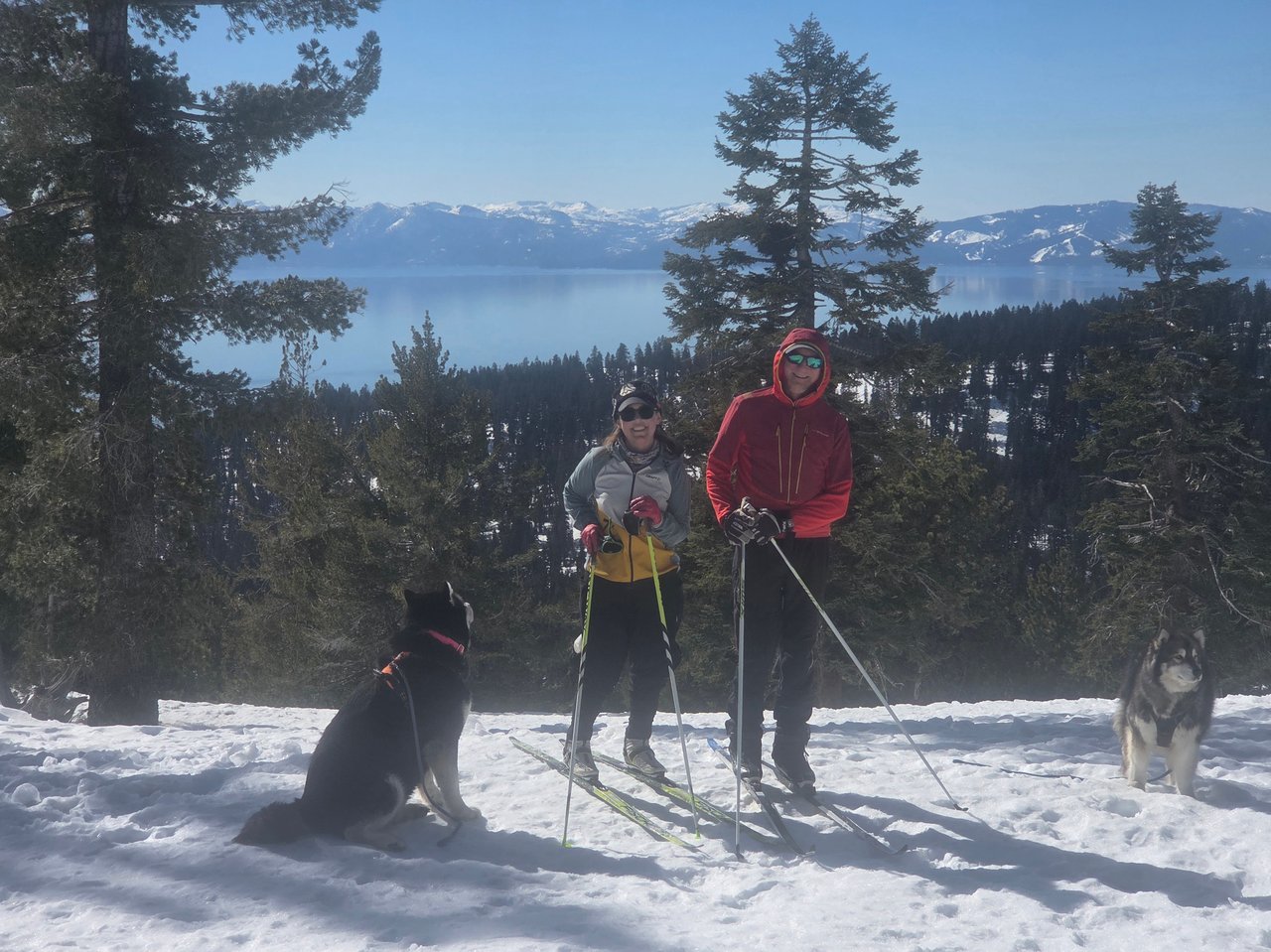
My coping mechanisms have been introspection and a quest for understanding; I learned more about common practices in advanced backcountry skiing, and related those practices to the risks that I regularly take. There was a time in my life when I enjoyed intermediate-level backcountry skiing adventures. As a less-experienced back country skier, I only ventured out to moderate angle pitches away from “starting zones” and only adventured on stable snow days with good visibility. This is not to say there weren’t risks, but as a less-educated backcountry skier, I went out on only the days with fewer risks. Even today, I venture out to gentle trails in unmitigated areas to enjoy skate skiing on groomed trails with a view of Lake Tahoe.
I recognize that as people increase their knowledge and understanding of backcountry conditions, more potential recreation days open up to them. As one of my friends has pointed out: there are “tigers” (risks) out there. If someone “gets eaten by a tiger” everybody wants to figure out how not to get themselves eaten. If you know a lot about “where the tigers are”, you feel more confident that you can avoid them. Case in point: in my preferred area of skiing (in-bounds resort skiing) I do know where a lot of the “tigers” lurk, and therefore feel confident in skiing a lot of different terrain in varied weather and snow conditions. I also take educated risks. One day it could be me who “gets eaten by a tiger” because the “tiger” does not care if I am an expert. That is another reason for the anger and why this tragedy is so personal for so many people; for so many of us, “it could have been me”.
The people who were taken at Castle Peak knew they were taking a risk, but they did not leave that day thinking that they would fail to return. In this tragedy, there are decisions and circumstances that we will never know. Much knowledge died with the souls that left that day, and secrets too horrible for the survivors to share will persist. After having gone through my own personal reckoning process, moving forward entails learning more and also setting my own feelings aside in order to focus on actively supporting the rescuers, the rescued, and the friends and families who will be mourning the losses of their loved ones for decades to come.
If you or someone you know is in need of mental health support, please use this link to connect to the closest available resource: https://211connectingpoint.org/castle-peak-avalanche-mental-health-resources/
If you want to donate to Tahoe Nordic Search and Rescue, please use this link:
https://www.tahoenordicsar.org/