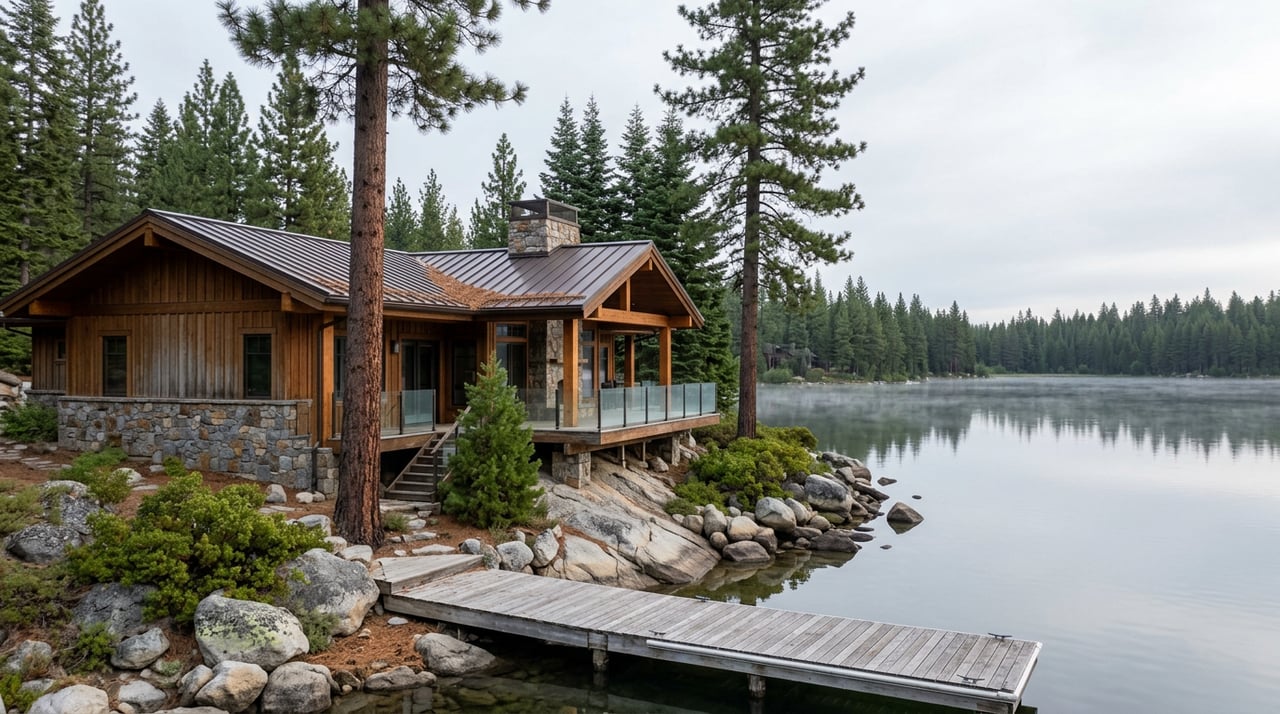
What does "lakefront" actually promise you in Tahoe City? Not the view. Not the square footage. Not even, in a surprising number of cases, the water itself.
Ask a buyer who found out during escrow that the pier they assumed came with the house was never legally theirs to use. It happens often enough that title companies and lakefront attorneys treat it as a routine line item, not an edge case. The house looks the same from the road whether the pier is permitted, shared, expired, or entirely absent. The price does not reflect that difference until someone goes looking for it.
The Word That Does the Least Work in a Tahoe Listing
"Lakefront" tells you a parcel touches the water. It does not tell you whether you can put a boat on it.
Every pier, buoy, boat lift, and mooring on Lake Tahoe falls under the Tahoe Regional Planning Agency, the bi-state agency that has governed shoreline construction since a takings case over its building moratoria went all the way to the U.S. Supreme Court in 2002. The Court sided with the agency, and TRPA's authority to control what gets built along the shore has held ever since.
For decades that authority meant close to nothing new got built at all. TRPA's Shoreline Plan, adopted in October 2018, lifted a moratorium that had been in place for years and finally set rules for how new piers, moorings, and boat ramps could be permitted. That sounds like it opened the floodgates. It did not. It replaced a total freeze with a lottery, and lotteries have odds.
A pier is a permit, not a promise, and permits do not automatically travel with a deed unless someone checks first.
Industry guidance on lakefront due diligence is blunt about this: a shoreline lot that looks like it should have a dock may have no permitted structure and no realistic path to one. Lakefront, lake-view, and mountain-adjacent are three different asset classes with three different rights, and confusing them is how buyers overpay.
What the Lottery Actually Produced
TRPA runs its pier lottery every two years. The most recent cycle opened in June 2025, with the drawing held on July 16, 2025.
Fifty-six single-parcel pier proposals came in. Fifty-two were eligible for the drawing. Two were selected, and both sat on the California side of the lake, which includes Tahoe City. Being selected is not the same as being approved. Selected applicants are invited to submit a complete application to TRPA, with a January 18, 2026 deadline for that next step, and standard review timelines apply from there.
Multiple-parcel, or shared, piers fared better. Of 22 proposals, TRPA allocated 11 for the 2025-2026 period. That gap between two single-parcel approvals and eleven shared approvals out of dozens of applicants is not an accident. TRPA's own prioritization criteria favor pier projects that serve multiple property owners over projects that serve one, which is a large part of why almost every pier a Tahoe City buyer will actually encounter belongs to a homeowners association rather than a single house.
That single fact rewrites how to shop this market. Waiting for a private pier to become available on your own parcel is closer to a hobby than a plan. Buying into an association that already holds a permitted, shared pier is the realistic path for nearly everyone.
Three Ways Buyers Actually Get on the Water
Three configurations show up again and again around Tahoe City, and they price very differently for reasons that have little to do with the house itself.
| Configuration | What you're actually buying | What can go wrong |
|---|---|---|
| Dollar Point (optional HOA) | Access to a gated beach and pier at 3000 Edgewater Drive, plus pool and tennis at 170 Observation Drive, shared among roughly 524 dues-paying members | Membership is optional and separate from the deed. A non-member buyer inherits nothing until they join and pay in |
| Sunnyside/Talmont (Lake Tahoe Park Association) | Shared use of 850 feet of frontage and two piers across five subdivisions, Talmont Estates, Sunnyside, Tahoe Park, Tahoe Woods, and Tahoe Park Heights | Homes in these same subdivisions range from roughly $500,000 for a small cabin to more than $30 million for true lakefront, so "in the association" says almost nothing about what you paid for |
| Lake-view only, no shorezone rights | A view, nothing more | The view has no deed protection. TRPA regulates tree removal along the shore, so growth or a neighbor's future construction can change what you're looking at |
Dollar Point sits on somewhere between 560 and 600 parcels, only 39 of them true lakefront, though roughly 40 percent carry some kind of lake view. The neighborhood takes its name from Robert Dollar, a lumber baron and philanthropist, and its HOA membership is optional, which matters more than it sounds like it should. A house inside the Dollar Point boundary does not come with pier access. Membership does, and membership is purchased separately from the home.
The Buy-In Number That Keeps Moving
Here is where the fine print gets expensive. Dollar Point's annual dues run close to $1,200, with an ownership transfer fee near $5,100 charged at sale. The initiation fee for a buyer who is not already a member is where sources disagree in a way worth flagging rather than smoothing over. One listing describes it as roughly $25,000. A more recent update puts it closer to $50,000.
That is not a rounding error. That is a five-figure swing on the single cost most likely to surprise a buyer who assumed the HOA amenities were baked into the purchase price. The lesson is not which number is correct today. The lesson is that this figure moves, it is not disclosed the way a standard HOA fee would be under California's usual condo disclosure rules, since it is explicitly structured as optional and exempt from those requirements, and the only reliable number is the one you get directly from the association before you write an offer.
Regulation Cuts Both Ways
TRPA's grip on the shoreline protects pier and buoy rights permanently once they exist. It does the opposite for views.
A lake-view home commands a real premium over a mountain-facing one, but that view is not fixed the way a deeded pier is. Tree growth changes it. New construction on a lower parcel can change it. TRPA regulates tree removal at Tahoe specifically to protect scenic character and water clarity, which means even a homeowner who wants to reclaim a lost view by cutting a tree needs a permit to do it, and there's no guarantee one gets granted.
There's a second regulatory detail buyers routinely miss on lakefront parcels specifically: coverage, meaning the amount of impervious surface such as roofs, driveways, and patios a lot is allowed to carry. Two homes with identical square footage can sit on very different coverage allowances, and a lot with room to expand under its cap is worth more than one already built out to the limit, even if they look the same from the street today.
Put together, the pattern is consistent. The things that look permanent, like a view, often are not. The things that look incidental, like a permit filed with a regional agency, are the actual asset.
Before You Write the Offer
A few questions answer more than a walkthrough ever will.
- Is the pier or buoy currently permitted, and is that permit in the seller's name or transferable to a new owner
- Is HOA membership optional, and if so, what is the current initiation fee and dues structure, confirmed directly with the association rather than the listing
- What is the parcel's current coverage usage against its allowed maximum
- If the home is lake-view rather than lakefront, what protects that view beyond hope
None of these show up in a standard listing photo. All of them show up in a title report, an HOA estoppel letter, or a direct call to TRPA's parcel lookup system, and all of them belong in your due diligence period, not discovered after you've removed contingencies.
A Few Questions Worth Asking
Can I just add a pier to my Tahoe City lakefront lot if it doesn't already have one? Only through TRPA's biennial lottery, and the numbers from the most recent cycle make the odds clear: two single-parcel piers approved out of 56 applications basin-wide. A shared pier through an existing HOA is the far more realistic path.
Does a lake-view home in Tahoe City ever come with shoreline rights? Not unless it's specifically deeded with them or holds membership in an association like Dollar Point or the Lake Tahoe Park Association. A view alone carries no shorezone permission.
Why do two homes in the same HOA sell for such different prices? Because the HOA gives you a shared amenity, not a guarantee of frontage. In Sunnyside and Talmont, homes in the same association range from roughly $500,000 to more than $30 million depending entirely on whether the individual parcel itself touches the water.
Understanding which asset you're actually buying, a view, a shared right, or a permitted private pier, is the difference between a smart Tahoe City purchase and an expensive surprise at closing. That kind of read takes someone who has spent time inside both the architecture and the paperwork of these properties. The Cutler Team works this market from both sides, design sense from Carina's architecture background and contract depth from Jeff's broker and attorney training, and they're glad to walk through what a specific Tahoe City property's water rights actually are before you make an offer.